
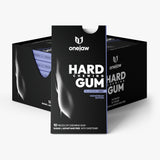
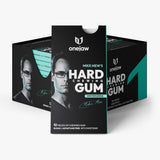
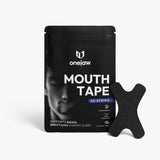


Everyone's taping their lips shut and calling it a fix for mouth breathing. Tape holds your lips together. It does nothing for your jaw.
Your chewing muscles have a job that has nothing to do with food. Along with your tongue held in light suction against your palate, they hold your mandible up while you sleep. Weak masseters and your jaw drops open regardless of what's taped across it. Once the jaw falls, your tongue follows it back into your airway, and tape can't reach that.
Persistent snoring, choking or gasping at night, and daytime exhaustion are worth a sleep study rather than a product. Obstructive sleep apnoea is a medical condition, and mouth taping is not appropriate for anyone with it, with nasal obstruction, or with a respiratory condition. Speak to your doctor first.
What the repair shift does
Sleep runs maintenance programs that don't run while you're awake. Snoring, choking, micro-arousals from a collapsing airway all cut those programs off mid-task, and the unfinished work stacks up night after night.
Your brain takes out its own trash
The glymphatic system is the brain's version of the lymphatic system. During deep non-REM sleep the space between your brain cells more than doubles, driven partly by nitric oxide from nasal breathing, and cerebrospinal fluid flushes through to carry out metabolic waste including β-amyloid and tau.
Fragment that sleep with apnoea-driven arousals and oxygen drops and the flush never finishes. You wake up carrying yesterday's waste, run the day on oxidative stress, and repeat.
Hormones reset overnight, or they don't
Growth hormone peaks in early deep sleep and repairs muscle, connective tissue and blood vessel lining. Melatonin syncs your circadian rhythm and works as an antioxidant. Leptin and ghrelin rebalance overnight, which is what keeps your appetite and metabolic control steady.
Interrupt the night and all of them get suppressed while cortisol climbs instead. One fragmented night blunts tissue repair and tilts your metabolism toward insulin resistance.
Your heart works the night shift too
Healthy sleep shifts you into parasympathetic mode. Sleep apnoea does the reverse, and every breathing pause becomes a small emergency: oxygen drops, adrenaline fires, your heart rate climbs to force the airway open. Blood pressure that should fall overnight stays elevated instead, and it does that several hundred times before morning.
Cells running on unstable oxygen
Slow nasal breathing keeps your oxygen and CO2 balanced through the night. Snoring and breathing pauses break that balance, and your tissues start running on intermittent hypoxia. Starve your mitochondria of steady oxygen and they pump out excess reactive oxygen species.
The immune system goes sluggish
Deep sleep activates natural killer cells and T lymphocytes while holding inflammatory cytokines in check. Fragmented sleep flips that: immune cells slow down and inflammatory molecules climb. You end up running on low-grade chronic inflammation.
Where the gum comes in
Tape solves the lip seal. It doesn't solve the jaw, which is why we make both.
Your masseter holds the mandible closed against gravity for seven or eight hours. That's an endurance job, not a strength job, and it's the same reason ONEJAW is calibrated rather than maximally hard. Two or three sessions a day builds the tone that keeps your jaw where it belongs overnight. Chewing the hardest gum you can find for one long session does the opposite: it fatigues the muscle and loads the joint you're trying to protect.
Train the masseter and the tape has something to work with. Skip it and you're holding your lips shut around a jaw that's already open.
The bottom line
Slow breathing, stable oxygen and unbroken rest let your body run a full maintenance cycle: brain waste cleared, tissue rebuilt, hormones synced, cardiovascular and immune systems reset.
Break that cycle and you start the next day with unfinished work. Most guys never clock it as a sleep problem, because you adapt. You run at 70%, decide that's your baseline, and never find out what full recovery feels like.