


The open suture: why some adult jaws never fully fuse
Most people assume their skull finished growing sometime in their teens and has been one solid piece of bone ever since. For a meaningful percentage of adults, that's not quite true.
Hidden beneath the gum tissue on the roof of the mouth, some people are still carrying a joint line that never fully closed.
What a "patent" suture is
The premaxilla is the small wedge of bone at the very front of your upper jaw — the part holding your four front teeth. Where it meets the rest of the maxilla, there's a seam called the premaxillary suture.
"Patent" simply means open. Un-fused. Still soft tissue where a solid bridge of bone would eventually form.
One distinction matters before going further, because it is the source of most of the confusion online. The premaxillary suture has two aspects, and they close on completely different schedules. On the facial side — the surface you could theoretically see from the front — it fuses before birth. No opening is visible even in specimens from the fourth month of gestation. It is the palatal aspect, on the roof of the mouth, that stays open into childhood and sometimes far beyond. When anyone discusses adult suture patency, that palatal seam is what they mean.
What's inside the seam
The suture isn't an empty crack. It's a thin, jagged line packed with collagen fibres and mesenchymal cells — living, wet and slightly elastic tissue rather than dead space.
Those pockets of collagen act like rubber dampeners between the interlocking bone edges. Laboratory work has identified genuine skeletal stem cell populations living in the suture midline, capable of self-renewal and of generating new bone. That research is currently in mice rather than humans, and the cells in question make up a fraction of a percent of the tissue, so it is best understood as a promising line of investigation rather than settled human biology.
What a patent suture does have is a degree of micro-mobility. It can yield by microscopic amounts when sustained force is applied to it — which is precisely why an orthodontic appliance can work on one.
How common is it, really?
The numbers shift a lot with age, and they shift depending on which suture is being measured.
In children up to about twelve, the palatal aspect of the premaxillary suture is open in essentially all of them. That is simply how the upper jaw grows and widens during development.
In adults, it becomes uncommon.
of adult skulls retained a measurable opening — 63 out of 1,022 — averaging about 41% of the suture's total length.
Salvatore et al. · 1,138 skullsWorth knowing: that study was done by direct visual inspection of dry skulls, not by CBCT. The authors specifically noted that radiographs failed to visualise the suture reliably.
A separate seam, the interincisive suture, runs along the midline between the two halves of the premaxilla and follows a different timeline. CT work published in 2025 found it open in roughly 76% of people aged 15–19, 54% at 30–34, and still open in up to 25% of the oldest patients studied. These are two different structures, and figures from one are routinely misquoted as figures for the other.
Why orthodontists care
For patients whose palatal sutures are still patent, orthodontists can use expander appliances to reshape the upper jaw and correct alignment issues without surgery. This is the basis for MARPE — miniscrew-assisted rapid palatal expansion — and similar devices.
A patent suture is essentially a pre-existing weak point in the skeleton. Because the joint hasn't locked into solid bone, an expansion appliance can open it with meaningfully lower risk of failure than trying to force apart a fully fused one. For some patients, this is the difference between an appliance-based approach and a surgical one, a procedure called SARPE.
The premaxillary suture is only one piece of the picture, and not the main one. An orthodontist assessing candidacy for expansion uses a CBCT scan to check the midpalatal suture — the main seam running down the centre of the palate — along with the circummaxillary sutures connecting the upper jaw to the cheekbones and skull.
The Angelieri scale: how welded is a suture?
Adult orthodontics leans on a staging system developed by Angelieri and colleagues to describe how fused a palatal suture is. It was designed for the midpalatal suture specifically.
- Stage A — a straight high-density line with little or no interdigitation.
- Stage B — a scalloped high-density line.
- Stage C — two parallel scalloped lines separated by small low-density spaces.
- Stage D — fusion has begun in the palatine bone, at the back. The suture is still visible in the maxilla.
- Stage E — fusion has extended forward into the maxilla. The suture is no longer visible along at least part of its length.
Fusion travels back to front, which is why the posterior palate locks down first. Stages A through C are considered patent; D and E are the point at which clinicians typically move toward bone-borne or surgically assisted expansion rather than conventional tooth-borne appliances.
A 2022 systematic review found conflicting inter-examiner reliability, described the method as non-intuitive and training-dependent, and was unable to pool any data linking a given stage to actual expansion success. It is validated against skeletal maturity, not against outcomes.
Does one open suture predict another?
There is an intuitive argument that it should. If suture closure is driven partly by your body's overall rate of osteogenesis — how quickly it converts soft connective tissue into solid bone — then someone whose early-fusing sutures stayed open past thirty might reasonably be running slow across the facial skeleton generally.
It is worth being straight about the evidence here: this is a hypothesis, not a finding. No study appears to have tested whether patency at one suture predicts patency at another within the same person. What the literature does show cuts slightly against a clean systemic signal — forensic work has repeatedly found suture closure to be non-linear and highly variable between individuals, to the point where it is considered unreliable for estimating age. Sutures appear to run on local schedules driven by local cues.
Which is the practical reason a scan checks each suture individually rather than inferring one from another.
Could you have one?
Because the suture sits beneath the gum tissue, it is invisible and cannot be felt with a finger or tongue. There is no home test, and applying hard pressure to your own teeth or gums to "check" is neither reliable nor a good idea.
A gap between the upper front teeth that appears or widens in adulthood is frequently claimed as evidence of underlying segment flexibility. The documented cause is usually something else entirely: pathologic tooth migration, most commonly driven by advanced periodontitis, and reported in 30–56% of moderate-to-severe cases. Gingival overgrowth from certain medications, posterior bite collapse and occlusal trauma also produce it.
A new or widening diastema in an adult is a reason to see a periodontist, not a hint about your sutures.
The only way to confirm and measure a patent suture is a CBCT scan — a 3D dental X-ray — which lets a clinician map the exact width and length of any remaining gap and stage it properly.
The bigger picture
A patent suture isn't good or bad on its own. It's a structural fact about where your skeleton sits in its fusion timeline, and some people are genetically predisposed toward incomplete fusion in specific areas of the face. What it explains is why some adults respond dramatically well to non-surgical palatal expansion while others, with the same complaint at the same age, need a surgical approach.
What it does not explain is anything you can act on by yourself. Chewing load does influence craniofacial growth, and sutures do register strain during mastication — but that work is in growing animals, and where it points, it points toward heavier masticatory strain being associated with earlier suture fusion, not preserved openness. There is no human evidence that chewing expands a palate. Anyone selling you that story is ahead of the science.
If you suspect this applies to you, the next step isn't a home test. It's an orthodontist and a CBCT scan. That's the only way to know which stage your sutures are actually in, and what that opens up.
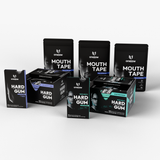
Nothing you chew will move a suture stage. What chewing load does influence is muscle, function and the airway — a different question, and the one our gum and mouth tape are actually built for.
This article is for general education and isn't a substitute for a professional orthodontic evaluation.